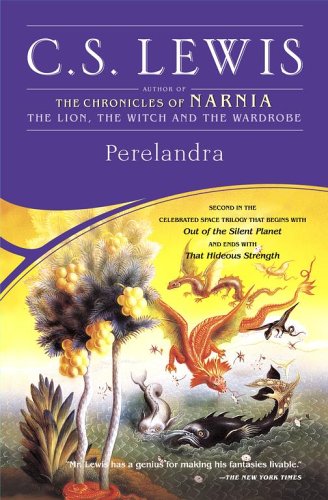
The last few weeks for my Special Topics English class we have been reading Out of the Silent Planet, Perelandra, and That Hideous Strength by C.S. Lewis. It has been a MIND BLOWING experience. Lewis is one of the most intelligent authors and theologians I have ever read. His descriptions bring places to life with details that appeal to all the senses, and when he describes a person to you, he comes at it not from a purely straightforward physiological standpoint, but rather, he aims at describing the way that person would make you feel if you were looking at them. This stands out to me particularly, because I hate it when authors try to paint a picture of someone's physical features, and then I still can't really grasp what they should look like.
Another thing I love about Lewis is that his writings take me outside the box spiritually, and he often addresses spiritual questions that I didn't even know I had, or had never considered. Many passages in Perelandra struck a cord with me. In the following, the demon-possessed man Weston is tempting the Green Lady (who is the Perelandran Eve), and Ransom (the main character) is attempting to intervene. Weston tries to convince the Green Lady that she should disobey God's orders not to sleep on the "Fixed Land" (most of Perelandra's land floats on a vast ocean), and that if she did so, she would actually be pleasing God and her husband the King by stepping out and taking the magnanimous risk of being her own person: "...[Weston] began to play on a fear which the Lady apparently shared with the women of earth--the fear that life might be wasted, some great opportunity let slip. 'How if I were a tree that could have born gourds and yet bore none,' she said. Ransom tried to convince her that children were fruit enough."
As soon as I read this passage my mind flew to the Scripture verses 1 Timothy 2:14-15: "[A]nd Adam was not deceived, but the woman was deceived and became a transgressor. Yet she will be saved through childbearing--if they continue in faith and love and holiness, with self-control." This is a difficult passage to interpret, since after all, not all women have children or even get married, and I confess that the very nature of these verses makes me cringe with slightly feminist pulses of frustration. But I realized as I read the Perelandra passage that Ransom was not telling the Green Lady that her only purpose in life was to be a wife and a mother...he was telling her to cling to the desires God had created her to have, and put in her heart--the desires that were holy and pure and beautiful. The Green Lady looked forward to being the first mother of Perelandra; she talked a great deal about her future children. It was a beautiful part of who she was. But she was also content with where she was at right in that moment, because her first Beloved was God, and her first desire was to please Him by enjoying what He was giving her in that very moment. Ransom doesn't understand this at first, because her husband the King has been missing for some unknown amount of time, and though she has missed him and watched for him, she is not anxious about his return. During a conversation where Ransom questions her peace about the situation, she says: "One goes into the forest to pick food and already the thought of one fruit rather than another has grown up in one's mind. Then, it may be, one finds a different fruit and not the fruit one thought of. One joy was expected and another is given...You could send your soul after the good you had expected, instead of turning it to the good you had got. You could refuse the real good; you could make the real fruit taste insipid by thinking of the other." A little while later in the conversation Ransom says: "But are you happy without the King? Do you not want the King?" "Want him?" the Lady says. "How could there be anything I did not want?"
The Green Lady knew what God had created her for, but she was also open to His will at all times. I think that maybe this is what the passage in 1 Timothy is about. It isn't that the act of giving birth will save a woman's eternal soul. It is the act of understanding and obeying God's will for her life, throwing herself in trust and love upon His Word rather than trying to listen to her own heart and striving in fear to fix things that only God can fix, to take control in situations where only God can be in control. These are natural, but often misleading desires in a woman--to make things right and to just "do it myself." Women can be very effective workers, intelligent people, nurturing leaders. But we cannot let those desires get in the way of God's plans, or take the place of God's commands.
The beauty of being a human being made in the image of God is that He doesn't control all our actions. We are individuals. The Green Lady describes this relationship with God like this: "I thought...that I was carried in the will of Him I love, but now I see that I walk with it. I thought that the good things He sent me drew me into them as the waves lift the islands; but now I see that it is I who plunge into them with my own legs and arms, as when we go swimming....It is a delight with terror in it! One's own self to be walking from one good to another, walking beside Him as Himself may walk, not even holding hands...I thought we went along paths--but it seems there are no paths. The going itself is the path."
But while God has made us individuals who make individual choices, He calls us into obedience born out of love. This is what Ransom suddenly realizes as Weston tempts the Green Lady to sleep on the Fixed Land. He realizes that although this command may seem to make no sense, may seem to have no logic behind it--that may be the very point: "I think He made one law of that kind in order that there may be obedience. In all these other matters what you call obeying Him is but doing what seems good in your eyes also. Is love content with that? You do them, indeed, because they are His will, but not only because they are His will. Where can you taste the joy of obeying unless He bids you do something for which His bidding is the only reason?" The Green Lady replies: "Oh, how well I see it! We cannot walk out of [God's] will: but He has given us a way to walk out of our will....It is like passing out through the world's roof into Deep Heaven. All beyond is Love Himself."
Another thing I love about Lewis is that his writings take me outside the box spiritually, and he often addresses spiritual questions that I didn't even know I had, or had never considered. Many passages in Perelandra struck a cord with me. In the following, the demon-possessed man Weston is tempting the Green Lady (who is the Perelandran Eve), and Ransom (the main character) is attempting to intervene. Weston tries to convince the Green Lady that she should disobey God's orders not to sleep on the "Fixed Land" (most of Perelandra's land floats on a vast ocean), and that if she did so, she would actually be pleasing God and her husband the King by stepping out and taking the magnanimous risk of being her own person: "...[Weston] began to play on a fear which the Lady apparently shared with the women of earth--the fear that life might be wasted, some great opportunity let slip. 'How if I were a tree that could have born gourds and yet bore none,' she said. Ransom tried to convince her that children were fruit enough."
As soon as I read this passage my mind flew to the Scripture verses 1 Timothy 2:14-15: "[A]nd Adam was not deceived, but the woman was deceived and became a transgressor. Yet she will be saved through childbearing--if they continue in faith and love and holiness, with self-control." This is a difficult passage to interpret, since after all, not all women have children or even get married, and I confess that the very nature of these verses makes me cringe with slightly feminist pulses of frustration. But I realized as I read the Perelandra passage that Ransom was not telling the Green Lady that her only purpose in life was to be a wife and a mother...he was telling her to cling to the desires God had created her to have, and put in her heart--the desires that were holy and pure and beautiful. The Green Lady looked forward to being the first mother of Perelandra; she talked a great deal about her future children. It was a beautiful part of who she was. But she was also content with where she was at right in that moment, because her first Beloved was God, and her first desire was to please Him by enjoying what He was giving her in that very moment. Ransom doesn't understand this at first, because her husband the King has been missing for some unknown amount of time, and though she has missed him and watched for him, she is not anxious about his return. During a conversation where Ransom questions her peace about the situation, she says: "One goes into the forest to pick food and already the thought of one fruit rather than another has grown up in one's mind. Then, it may be, one finds a different fruit and not the fruit one thought of. One joy was expected and another is given...You could send your soul after the good you had expected, instead of turning it to the good you had got. You could refuse the real good; you could make the real fruit taste insipid by thinking of the other." A little while later in the conversation Ransom says: "But are you happy without the King? Do you not want the King?" "Want him?" the Lady says. "How could there be anything I did not want?"
The Green Lady knew what God had created her for, but she was also open to His will at all times. I think that maybe this is what the passage in 1 Timothy is about. It isn't that the act of giving birth will save a woman's eternal soul. It is the act of understanding and obeying God's will for her life, throwing herself in trust and love upon His Word rather than trying to listen to her own heart and striving in fear to fix things that only God can fix, to take control in situations where only God can be in control. These are natural, but often misleading desires in a woman--to make things right and to just "do it myself." Women can be very effective workers, intelligent people, nurturing leaders. But we cannot let those desires get in the way of God's plans, or take the place of God's commands.
The beauty of being a human being made in the image of God is that He doesn't control all our actions. We are individuals. The Green Lady describes this relationship with God like this: "I thought...that I was carried in the will of Him I love, but now I see that I walk with it. I thought that the good things He sent me drew me into them as the waves lift the islands; but now I see that it is I who plunge into them with my own legs and arms, as when we go swimming....It is a delight with terror in it! One's own self to be walking from one good to another, walking beside Him as Himself may walk, not even holding hands...I thought we went along paths--but it seems there are no paths. The going itself is the path."
But while God has made us individuals who make individual choices, He calls us into obedience born out of love. This is what Ransom suddenly realizes as Weston tempts the Green Lady to sleep on the Fixed Land. He realizes that although this command may seem to make no sense, may seem to have no logic behind it--that may be the very point: "I think He made one law of that kind in order that there may be obedience. In all these other matters what you call obeying Him is but doing what seems good in your eyes also. Is love content with that? You do them, indeed, because they are His will, but not only because they are His will. Where can you taste the joy of obeying unless He bids you do something for which His bidding is the only reason?" The Green Lady replies: "Oh, how well I see it! We cannot walk out of [God's] will: but He has given us a way to walk out of our will....It is like passing out through the world's roof into Deep Heaven. All beyond is Love Himself."

So glad you're enjoying Lewis and the trilogy! It is truly mind-blowing! And I never get tired of it. You've made some good connections with scripture; I'll be interested to see how your thoughts develop re: obedience (which Lewis helps me see in a whole new light) and gender issues. I'm always amazed that a confirmed bachelor Oxford don could write so sympathetically and accurately about women!
ReplyDelete